|

|
Campo
Santa
Maria Formosa
|
Church of Santa Maria Formosa
|
Cut across Campiello
Querini Stampalia, go under the sotoportego and you
will be in elegant Campo Santa Maria
Formosa.
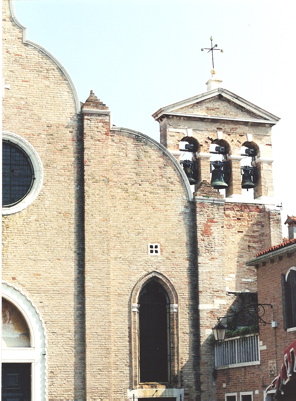
The church was rebuilt by Mauro Codussi at the end of the 15th century.
Its interior is divided into square sections separated by low columns
and arches which give the church a more human dimension. It contains
two amazing paintings, Santa Barbara
by Palma il Vecchio and Madonna of Mercy
by Bartolomeo Vivarini. During my last visit on a cold December
afternoon the church was completely packed and several priests all
dressed in white were celebrating mass in the Coptic rite.
|

|
|
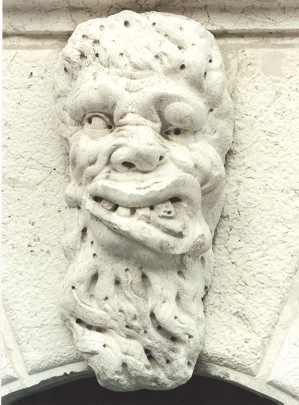
Walk around the campanile
and on the canal side, above the doorway you
will see a grotesque sculpture that inspired John Ruskin to say: "A
head -huge, inhuman, monstrous, leering in bestial degradation". I
personally think that this scacciadiavoli
(scaredemons) is just comical. Campo Santa Maria
Formosa
is the perfect place to unwind, sit down have a cup of coffee and read
a book, engage in conversation or just watch people walk by.
|

|
|
Fondamenta
dei Preti
|
Ponte del Paradiso
|
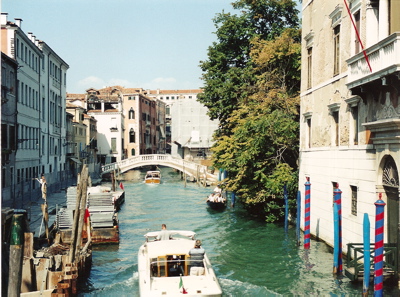
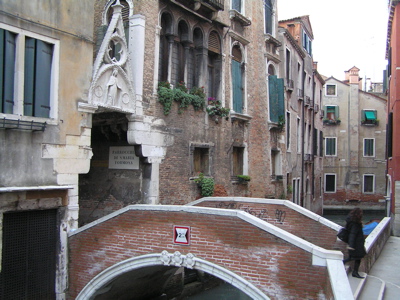
Leave the campo by the
canal side, Fondamenta dei Preti. Before you
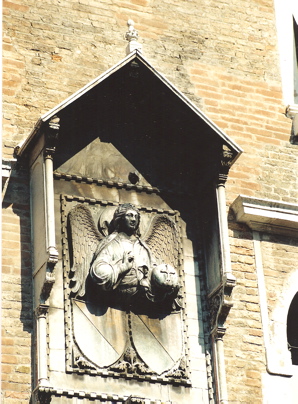
reach Ponte del Paradiso you will see on your right an old funerary urn
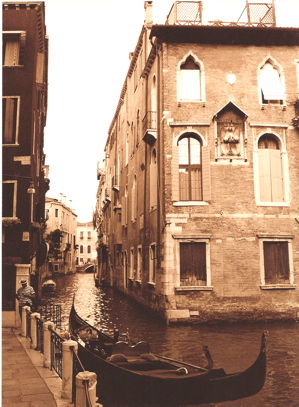
inserted in the corner of a building and across the canal, Rio del
Pestrin, a beautifully decaying façade pierced by Gothic
windows.
Vivaldi used to live in this building at number 5879. Right across from
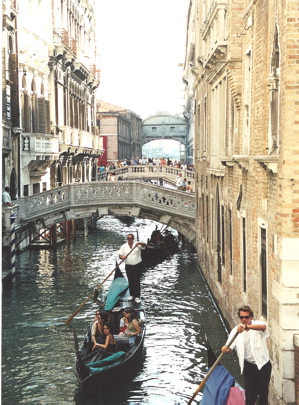
the entrance to the building is Ponte del Paradiso with the Gothic arch
and the relief of the Madonna
della Misericordia. Calle del Paradiso in one of the most
charming corners of Venice. It combines a Medieval ambiance with a
truly mercantile attitude. If we take Calle del Paradiso we will end up
in Salizada San Lio, instead we will continue on the side of the canal,
Fondamenta del Dose, that leads to Calle del Dose and Calle de
Borgoloco where we turn left. This will take us to Campo Santa Marina.
|

|

|
Gothic
window
|
For many years Vivaldi lived here
|

|

Rio del Pestrin from Ponte dei Preti
|
Roman
funerary urn by Ponte dei Preti
|
|
Campo Santa Marina is one
of the few campi
in Venice named after a saint and without a church. The church of Santa
Marina stood at numbers 6067 and 6068 but was demolished in 1820. It is
visible in Jacopo de' Barbari's map. Across from the Hotel Santa Marina
is Pasticceria Didovich
(Castello 5909) where you will find a fantastic assortment of pastries
plus some delicious vegetable tarts called salatine. Giovanni Bellini lived in
the parish of Santa Marina. He died on November 29, 1516 and was buried
alongside his brother Gentile in the Scuola de Sant' Orsola, next to
the
church of Santi Giovanni e Paolo.
|

de' Barbari's view of campi San Lio, Santa Maria Formosa, Santa Marina
and Santi Giovanni e Paolo
We exit Campo Santa
Marina by Calle del Frutariol and make a right turn
at Calle de la Malvasia where at number 5987 we will find another
Didovich store to tempt us one more time. We continue on Calle
del Pistor where just before crossing the bridge, Ponte del Pistor, the
excellent bakery Ponte delle Paste
is located. After crossing the bridge the street will take us back to
Campo San Lio.
|

|

|
Campo
Santa
Marina
|
Campo Santa Marina
|

|

|
Real canoce
|
Marzipan canoce at "Didovich"
|

We begin our walk in
Campo Santa Marina which we exit by Calle and
Ponte del Cristo. From Ponte del Cristo there is a view that may
succeed in capturing the essence of Venice if that's possible. As we
cross the bridge we enter Cannaregio. We turn right on Ponte de le
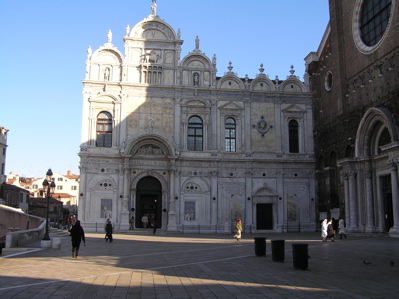
Erbe. The next bridge is Ponte Rosso from where we have a great view of
Rio dei Mendicanti and the Scuola di
San Marco. Hidden from view to the
right is the church of Santi Giovanni e Paolo (San
Zanipolo.)
|

|
Scuola Grande di San Marco and church of Santi Giovanni e Paolo
|
Rio
dei
Mendicanti from Ponte Rosso
|
|
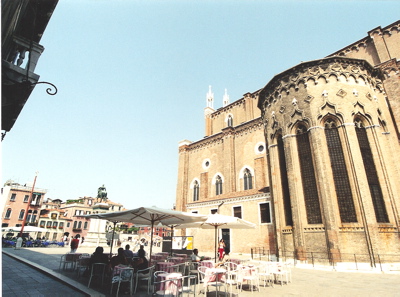
Campo Santi Giovanni e
Paolo is the perfect spot to sit down for a
drink or a cup of coffee. Rosa Salva,
a Venetian institution that offers delicious pastries and savory
treats, is conveniently located just across the side entrance of the
church. Impressive stained-glass windows, a rarity in Venice, grace the
church of Santi Giovanni e Paolo considered the Venetian Pantheon
because many doges are entombed here. The Scuola di San
Marco houses the Civic Hospital. Its façade, a work of Pietro
Lombardo
and Mauro Codussi was recently restored. Get close to the main door and
admire the amazing tromp d'oeil.
The beautifully
sculpted wellhead in the middle of
the campo was moved here in 1825 from its original location in the sestiere of San Marco . The equestrian statue, a design
by Andrea Verrocchio, shows the mercenary
captain, condottiere,
Bartolomeo Colleoni who victoriously commanded the Venetian
land forces for many years. In his will he left most of his fortune to
the Venetian state on condition that a monument be erected in his honor
in front of San Marco. His wish was granted, almost. The statue was
erected in front of San Marco, the
Scuola not the Basilica
as he had intended. It should be noted that the Venetian abhorred the
cult of personality. In the ten centuries of the Venetian Republic no
public figure had a statue erected anywhere in the city, much less in
Piazza San Marco.
|

Gentile (left) and
Giovanni Bellini (right) and between them a white-haired man. Detail
from Gentile Bellini's Procession in
the Piazza San Marco.
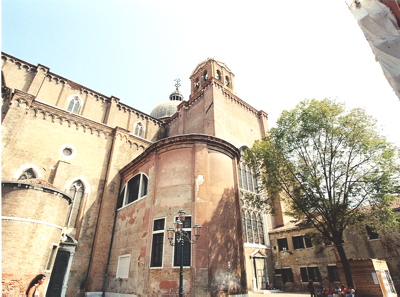
The church of Santi
Giovanni e Paolo is the home of many works by
Pietro, Antonio and Tullio Lombardo and a rare nine-panel painting by
Giovanni Bellini, Saint Vincent
Ferrer that contains a poignant Saint Sebastian. The former
Scuola di Sant'Orsola, for which Carpaccio's Saint Ursula
cycle was originally painted (now at the Accademia) stood next to the
apse of the church. The Bellini brothers, Gentile and Giovanni were
buried in this small scuola.
|

|

|
|
|
|
|
|
|
|
You can walk to the Fondamente Nuove, the northern edge
of the city, by the side of the hospital. From there you'll have a
splendid view of the lagoon and the island of San Michele, the resting
place of many personalities: Igor Stravinsky, Ezra Pound, Sergei
Diaghilev, Joseph Brodsky and Christian Doppler among many others. It
was precisely Joseph Brodsky who in his brilliant Venetian reflection "Watermark" wrote the following
words about this corner of Venice:
"I remember one day -the day I had to
leave after a month here alone. I had just had lunch in some small
trattoria on the remotest part of the Fondamente Nuove, grilled fish
and half a bottle of wine. With that inside, I set out for the place I
was staying, to collect my bags and catch the vaporetto. I walked a
quarter of a mile along the Fondamente Nuove, a small moving dot in
that gigantic watercolor, and then turned right by the hospital of San
Giovanni e Paolo. The day was warm, sunny, the sky blue, all lovely.
And
with my back to the Fondamente and San Michele, hugging the wall of the
hospital, almost rubbing it with my left shoulder and squinting at the
sun, I suddenly felt: I am a cat. A cat that has just had fish. Had
anyone addressed me at that moment, I would have meowed. I was
absolutely, animally happy."
|
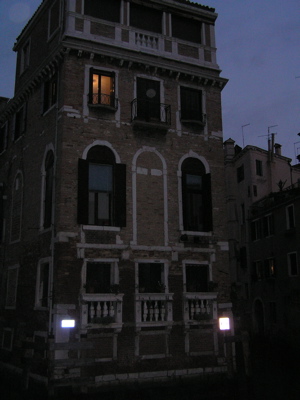
Palazzo Tetta at dusk
|
Exit
Campo San Giovanni e Paolo by the side of the church, Salizada
San Zanipolo, and turn right on Corte Veniera. This will take you to
Fondamenta dei Felzi. From the beautiful iron bridge, Ponte dei Conzafelzi, you will have
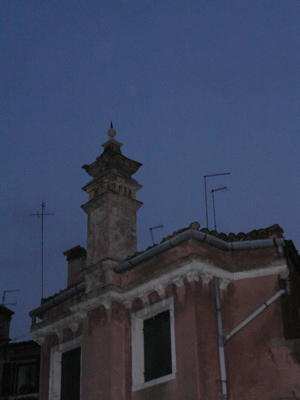
the perfect view of the most remarkable building,
Palazzo Tetta, that cuts the canal in two like a ship cuts the waters
of the ocean. As you face the palazzo, look up to your right where you
will see a
remarkable chimney that for a moment will make you
forget that you are in Venice and will take you to the Far East. As I
as was wandering in this area of Venice some years ago, I saw a
handwritten sign posted on a front door that
read "Si pregano i signori 'Animali' di lasciare libera la porta dall'
inmondizia (loosely translated as: "We beg the animal gentlemen to keep the
door free of garbage." This was one of many such signs that I
had seen scattered
in different corners of the city and I couldn't help but think that for
a republic to survive for a thousand years, diplomacy must
be ingrained in its citizens' DNA. |
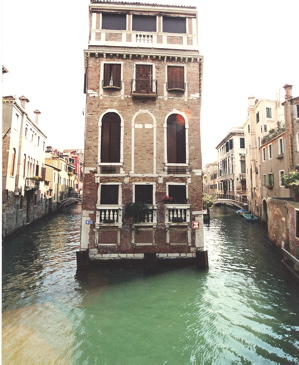
Rio de S. Giovanni Laterano, left,
and
Rio de la Tetta, right
|
|

|
We take Calle Pinelli
that ends at Calle Longa Santa Maria Formosa
where we turn left. You will soon be on Fondamenta and Ponte Tetta.
Unlike its more famous cousin Ponte delle Tette in the sestiere of San
Polo named after the flashy-fleshy merchandise displayed by many of the
prostitutes
that lived in the area, the ' Tetta'
of this remote part of Castello refers to the noble family Tetta who
had their residence in the palazzo
around the corner. After crossing Ponte de l'Ospedaleto you will be on
Calle de l'Ospedaleto that will take you to Barbaria de le Tole. To
your left is the ornate façade of the church Santa Maria
dei Derelitti or 'de l'Ospedaleto' (a work by Longhena). This
church like Vivaldi's La
Pietà has a long and distinguished musical tradition.
|
The
area around Rio de San
Giovanni Laterano seems like a very remote part of Venice but don't let
the absence of tourists fool you. From antique dealers to marble
artisans they all have their shops here, especially on Barbaria de le
Tole that
soon becomes Calle del Cafetier at the end of which is Campo de Santa
Giustina or Barbaria. In this campo is a small free-standing building,
the Oratorio
Beata Vergine Addolorata, one of the few of its kind remaining in
Venice.
|
|
|
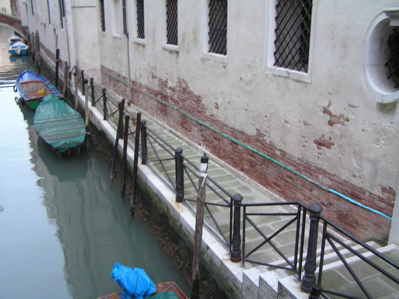
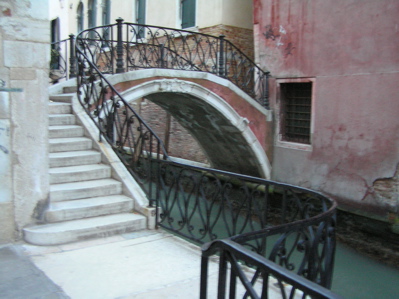
Rio de
S.
Giovanni Laterano
|
Ponte Capello on Rio de la Tetta
|
We take Calle Zon and
after
crossing the bridge we turn left on Fondamenta Santa Giustina and
immediately right on Calle San Francesco
de la Vigna from where you will see half the façade of the
church San Francesco de la Vigna designed by Andrea Palladio. The
church was built using the number three, a reference to the Holy
Trinity, as an important design element. The interior has the splendid
painting by Antonio Falier da Negroponte, " Madonna and Child," a stunning
transition piece between Gothic and Renaissance styles as well as many
other works by Giorgione, Vivarini and Giovanni Bellini. The vineyards
after which the church is named are unfortunately closed to the public.
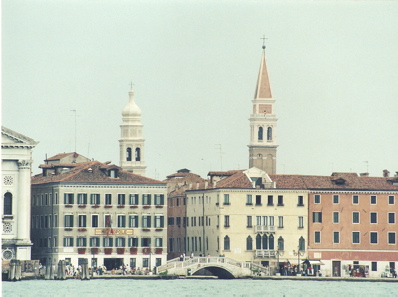
Bell towers of the churches of Sant'Antonin (left) and
San Francesco de la Vigna (right) from the island of San Giorgio
Maggiore
|
We exit the area by the
side of
the church, Campo de la Confraternita where I once saw a graffiti that
said:
"OKKUPARE
GLI SFITTI
BLOCCARE
GLI SFRATTI
LA CASA E UN DIRITTO!"
(Occupy the vacant
houses. Block the evictions. Housing is a right.)
And I couldn't help but think how strange that in a place with so many
vacant houses, housing could still be a problem. Follow the street
Corte drio de la Chiesa and after a few turns and bends you will be in
Campo de la Celestia, one of the few campi
in Venice that actually has grass. This area of Venice, behind the
Arsenale, has a number of blocks with relatively new apartment
buildings. In a small corner of the campo I once saw a ten-year old
girl selling her treasures all lovingly arranged on the pavement
stones:
a postcard, a comb, a pencil, a transparent plastic purse shaped like a
heart with a vibrant red rim and red handles. I couldn't help but think
that for a republic to survive for a thousand years, entrepreneurship
must
be ingrained in its citizens' DNA. I should have put my inhibitions
aside and bought that purse.
From Campo de la Celestia take Fondamenta del Cristo and cross Ponte
del Suffragio or del Cristo and you will be in lovely Campo Santa
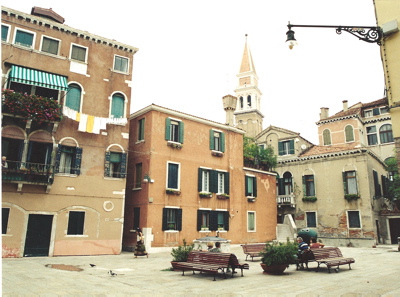
Ternita (Holy Trinity). Sit down in one of the benches and enjoy the
intimate setting: the campanile,
the chimneys, the beautiful wellhead, the two bridges, the sound of
running water, the color-coordinated laundry hanging from the windows,
and the old ladies peeking from their balconies decorated with
cartoonish wooden flowers. This is Venice at her best.
|
|
Arsenal
|
We start our walk on Riva
degli Schiavoni by Ponte de la Ca' di Dio. We
cross the next bridge, Ponte de l'Arsenal, and turn left on the
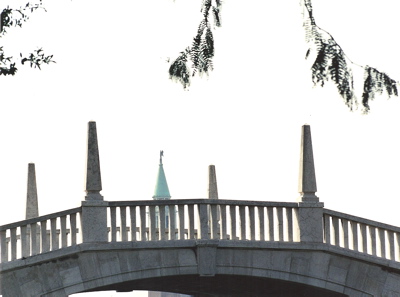
fondamenta. The little grassy area under the trees is very inviting
indeed with a view of the bridge, the Riva and San Giorgio Maggiore in
the background. If you are lucky and you are visiting Venice the day
before the Regata
Storica,
held the first Sunday in September, Rio de l'Arsenal is the perfect
spot to have a close view of some of the magnificent boats that would
be on parade the next day as many of them are moored overnight in this
area of Venice.
|

Rio de l'Arsenal before Regata Storica
|

Rio de l'Arsenal before Regata Storica
|
|
|
 |

|
Rio de
l'Arsenal before Regata Storica
|
Regata
Storica, 2002
|
We continue on to the end
of the
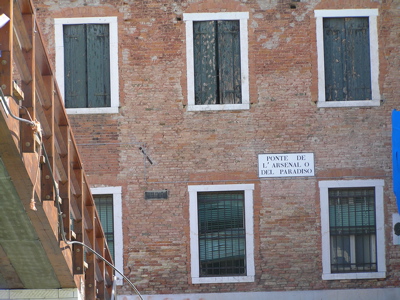
fondamenta where we cross Ponte de l'Arsenal or del Paradiso to Campo
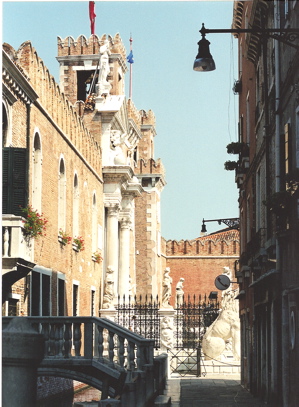
de l'Arsenal. In this picturesque campo we can admire the entrance to
the Arsenal,
which for many centuries was the engine behind Venice's power. Here is
where the Venetian ships were built as early as in the 12th century.
The assembly line was an integral part of the Arsenal's operation way
before Henry Ford, credited with inventing it, put it to use for
automobile manufacture in the USA. The word Arsenal (Arsenal in
Venetian, Arsenale in Italian) is derived from the Arabic word Dar al
Sina'a meaning dockyard, workshop. From Venice the word has transcended
into most European languages with a slightly different meaning.
|
|

|
|
Unmistakable symbols of
Venice,
several lions guard the entrance to the Arsenal, beginning with the one
on top of the portal. However, the most curious one is the lion to the
west side of the entrance. It is a spoil of war brought by Doge
Morosini in 1687 from Piraeus (the port of Athens). It has some
Runic symbols engraved on its shoulder, probably the work of a Norse
soldier fighting for the Byzantine emperor in the 11th century.
|

|

|
|
Dante visited the Arsenal
in two
occasions in 1306 and 1321. The impression that the place made on him
must have been very strong as the Canto XXI of his Inferno testifies. A
marble plaque on the side of the main portal commemorates this.
As in the Arsenal of the
Venetians, in winter, the sticky pitch for smearing their unsound
vessels is boiling, because they cannot go to sea, and, instead
thereof, one builds him a new bark, and one caulks the sides of that
which hath made many a voyage; one hammers at the prow, and one at the
stern; another makes oars, and another twists the cordage; and one the
foresail and the mainsail patches,—so, not by fire, but by divine art,
a thick pitch was boiling there below, which belimed the bank on every
side. I saw it, but saw not in it aught but the bubbles which the
boiling raised, and all of it swelling up and again sinking compressed.
If it's open, Bar
Arsenale is the perfect place to sit down and unwind while taking in
the view. If not, continue on Fondamenta de Fazza Arsenal. It will lead
you to the church and Campo di San Martin.
|

|
|
Saint Martin of Tours is
a
cosmopolitan saint, a true son of the Roman Empire. Born in 316 in
Sabaria (modern Szombathely in Hungary, near the Austrian border), he
was educated in Pavia, present-day Italy, and became a soldier in the
Roman Army. Drawn from very early in his life to Christianity, newly
proclaimed a legal religion in the Empire, Martin was forced by his
father to join the Roman army as a way to dissuade him from entering
the religious life. In what became the most famous incident of his
life, at the age of 21 he gave half of his cape to a shivering beggar
he encountered at the gates of Amiens (France). He kept the other half
because it belonged to the Roman Army. The relics of the cape were
guarded in France by a custodian called capellanus, a term from which the
words chaplain and chapel derive. The feast of Saint
Martin is celebrated on November 11th. In Venice a traditional cookie
in the shape of a horse with a rider wearing a cape is baked for such
occasion. The church of San Martin (Venetian)
or San Martino (Italian) was built in 1550 by Sansovino. Among the
works of art it contains, the ceiling fresco by Domenico Bruni and
Jacopo Guarana is a remarkable tromp
d'oeil.
|

Campo San Martin
|

San Martin giving his cape to a beggar
(marble plaque next to the church)
|
|
|
Giardini
We begin our walk on
Ponte de l'Arsenal. As we walk on Riva San Biagio
the Museo Storico Navale and the church of San Biagio will be on our
left. As we cross the next bridge, Ponte de la Veneta Marina or de le
Cadene, the wide Via Garibaldi will be on our left. Giovanni Caboto,
the New World explorer credited with discovering Canada while at the
service of King Henry VII, and his son Sebastiano Caboto, explorer of
South America, lived in corner house (Castello 1642).
|

|

Via Garibaldi
|
Caboto
lived
here
|
|
|
Via
Garibaldi was built on a filled-in canal in the Napoleonic period.
Today
it is not only the commercial hub of this part of Castello but also the
gateway to the Giardini Publici. Il
Nuovo Galeon is a wonderful restaurant on Via Garibaldi
(Castello 1308, right across the church of San Francesco da Paola) to
have fresh and perfectly cooked seafood and succulent pastas in a
friendly atmosphere. We walk to the end of Via Garibaldi where the
canal begins (Rio de Sant'Anna) and take the fondamenta on the left of
the canal, Fondamenta S. Gioachin. This is a very colorful area of
Venice that exudes local character. We make a left turn at the end of
the fondamenta on Calle drio el Forner that will take us to Fondamenta
del Forner. We cross Ponte Rielo and ahead of us is Calle Ruga where we
turn left; after crossing the campo, the street becomes Salizzada
Streta. At the intersection with Calle Larga de Castello we turn right.
This takes us to the long bridge of San Piero and to the Campo and
Church of San Piero (San Pietro di Castello in Italian).
|

|

|
Rio de
Sant'Anna
|
Rielo
and
Ponte Rielo
|
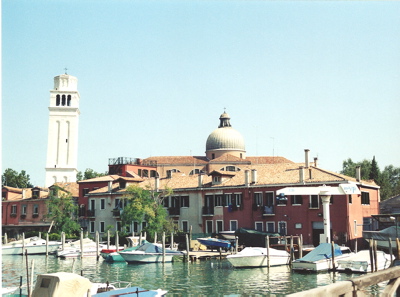
San Piero de
Castello was Venice's cathedral until 1807. Its remote location is
testimony of the distance that for centuries separated the political
power centered around San Marco and the Vatican. The citizens of La
Serenissima always felt that they were Venetians first and then
Christians (veneziani, poi cristiani.)
The free-standing campanile is very easy to recognize from a distance,
not only because is slightly leaning but also because it is one of the
few totally clad in white Istrian stone, a work of Mauro Codussi (end
of 15th century).
|
|
I visited the church on a
Sunday
morning in the middle of Communion, at the end of the 10 o'clock Mass.
The church was packed like the end of the world was imminent.
Respectfully, I left and sat outside in the beautiful campo, under the
trees. After several days of carrying my photographic equipment around
town for hours on end, my back had reacted with unbearable pain; the
hard wooden benches on Campo San Piero were not helping. Fifteen
minutes passed and hearing intense clapping inside but seeing no one
coming out of the church I decided to go in again. A priest was
speaking
in terms that I didn't fully understand. I must have taken ten steps
inside the church when several folks gave me a look that paralyzed me
in my tracks. Trying to find a surface to lean on to alleviate my
backache, I gave two more steps to position myself next to a column and
got the same look again this time accompanied by a loud shush. I felt
that I had violated some ancient and mysterious rule. I couldn't deny
after all that I was a tourist like a million others. I was embarrassed
and a little perplexed by such unexpected reaction; I have always found
Venetians to be a very polite and tolerant people. I later learned,
through fliers posted all around this area of Castello, that the
parishioners were honoring and giving thanks to Don Gabriele for seven
and a half years of ministry and I couldn't help but think how typical
Venetian the whole affair was. The parishioners didn't stop me when I
walked in in the
middle of Communion but they objected when I dared to walk during the
priest's farewell... Veneziani, poi
cristiani.
During my wait outside the church I got my reward. A Maltese dog like
the one in San Augustine in His Study
was lying next to me and I felt Carpaccio's ghost sitting on my
shoulder.
|

|

|
|
We leave the campo by
Calle drio
el Campanile that takes us to Calle and Ponte de Quintavale. After
crossing the bridge we will be on Rio de Sant'Anna one more time. We
continue on the fondamenta to the entrance to the Giardini Publici with
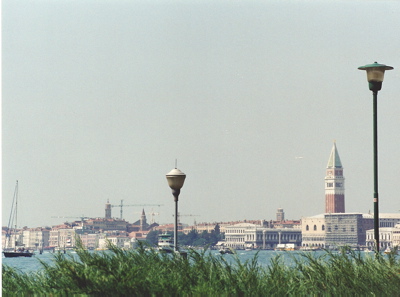
its monument to Giuseppe Garibaldi. From the Giardini we have one of
the most beautiful panoramas of Venice's skyline. No photo can capture
the view, especially at sunset when the black silhouettes of La Salute
and San Marco contrast against a crimson sky. Perhaps this is one of
those instances when a few words can say more than a thousand pictures;
especially when they are George Sands':
"The sun had already set behind
the hills of Vicenza. Great purple clouds were passing over the
Venetian sky. The tower of San Marco, the dome of Santa Maria and the
nursery-garden of spires and steeples rising from every corner of the
city stood out as black needles against the sparkling horizon. The sky
turned by subtle gradations from cherry red to cobalt blue while the
water, smooth and clear as a mirror, faithfully reproduced its infinite
iridescence; it lay like a vast sheen of copper below the city. Never
have I seen Venice more beautiful and enchanted. Its black silhouette,
cast between the sky and the glowing waters as on to a sea of fire,
seemed to be one of those sublime architectural aberrations the poet of
the Apocalypse must have seen floating on the shores of Patmos as he
dreamt of the New Jerusalem and likened it in its beauty to a newly wed
bride." George Sand, 'Lettres
d'un Voyageur.'
|
Inside
the Giardini we take
Viale Trento and then turn left on Paludo San Antonio. This will take
us to the district of Sant'Elena. This is one of the newest areas of
Venice. Contrary to what many people, some Venetians and travel books
writers included, may say I think that this is an enchanting area of
Venice. Granted that there are no impressive palazzi or works of art to
admire but Sant'Elena is only a short vaporetto ride away from all of
that while its residents have the luxury of enjoying a lush
surrounding. As you walk on Viale Quattro Novembre on a sunny summer
afternoon underneath a refreshing tree canopy you can enjoy the
spectacular view of the Bacino di San Marco on one side framed by a
backdrop of distant islands, and on the other, amid unpretentious
but charming architecture, the many little gardens with rosebushes and
oleanders in bloom.
We make a left turn on Viale Piave. This takes us to Ponte Sant' Elena
and finally to the austere church of Sant'Elena.
|

Many places around the world are named after Saint Helena, Constantine
the Great's mother and the godmother of Christianity, but this tiny
area of Venice is the real deal. Forget the Saint Helens of volcanic
proportions or the Saint Helenas of Napoleonic and Napa-Valley fame,
the unassuming church of Sant'Elena almost falling off the map of
Venice, is the only place that deserves to be called such, as it houses
the relics of the saint. Her remains are displayed in a glass
sarcophagus in one of the side chapels to the right of the entrance.
Dressed in a golden gown she wears a mask and slippers. As I sat all by
myself in the deserted church in front of her relics, I felt 1500 years
of history condensed in one indivisible moment as I pondered how one
single woman could have so dramatically changed the faith, and in doing
so the fate, of the Western world.
The picture to the left is the right bottom corner of de' Barbari's
map. Below the Subsolanus wind we can see only half of the
façade of Sant'Elena, indicating the lack of importance of this
peripheral area. The island was cut off from the rest of Venice.
|
|
After leaving the church,
we go
back to the Viale dei Giardini Publici. We cross Ponte San Domenego and
take Riva dei Sette Martiri (named after seven Venetians shot by the
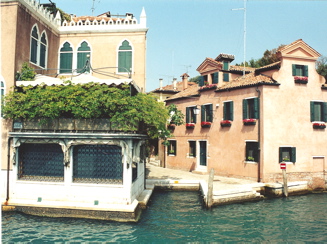
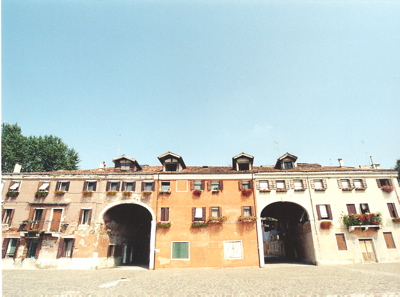
Nazis) on our way back to San Marco. To our right are the twin
entrances
to La Marinarezza, a housing project first built in 1335. The building
can be seen in de' Barbari's map.
|
From Ponte de San
Domenego
|
Casa della Marinarezza
|
This ends our tour of the
sestiere di Castello.
|

|