
Around San Marco
|
Around San Marco |
|
| It
is hard to think of any hidden corners in the most visited district of
Venice, San Marco, where
thousands of
tourists get lost every day, but some of San Marco's most interesting
treasures are hidden in plain sight. Take for example the curious
inhabitants on top of the two columns by the waterfront, in an area
called the Molo, near the
Doge's Palace: A
winged lion, a soldier and a dragon. The winged lion is the symbol of
Saint Mark, the patron saint of Venice. The soldier is Saint Theodore
(San Todaro),
a Greek general who used to be Venice's patron saint until demoted upon
the arrival of the stolen body of the mightier San Marco, an
evangelist, no less. The dragon under
Saint Theodore feet is a later addition of unclear
pretensions. The lion, the dragon and the soldier bore witness to
hundreds of executions carried by the state. Criminals, murderers,
traitors and even homosexuals were hanged, decapitated or burned alive
between the two columns. It is reassuring that Venice showed, once
again, her egalitarian side, albeit in its most macabre angle. The two
columns which were the ceremonial gate to Venice, the welcoming
entrance to kings and princes, were also the place where so many
unfortunate souls took their last breaths. Walking between the columns
is considered bad luck and superstitious Venetians avoid it even
today. |
 |
 |
| The
statue of Saint Theodore is a pastiche: The head is a portrait of king
Mithridates, from Pontus; the body is that of a Roman soldier and dates
from Hadrian's times. The dragon dates from the XV century. The
original sculpture is kept in the Doge's Palace; what we see on top of
the column is a reproduction. The lion didn't fare much better. While
its origin is debated -it's believed to be either Etruscan, or Persian
or even Chinese- the book and the wings were added later to make it a
true lion of Saint Mark. It was taken to Paris by Napoleon's army in
1797, at the fall of the Venetian Republic, and brought back in pieces
in 1815. It was once covered in gold. The granite columns where they
stand were brought from Syria in 1172. Venetians didn't know how to set
them up until Nicolò Quarattieri, a Lombard engineer, took up
the
challenge in 1180, in exchange for the rights to set up a gambling
stand between the two columns. |
| Map
of Venice |
 |
A
few meters away from the Molo,
under the arches of the Procuratie
Nove, is Caffè
Florian, the first coffeehouse opened in Italy and in operation
since
1720. Its first owner, Floriano Francesconi, called it Alla Venezia Triomfante. A detour
at Florian is a must; you
will be sitting in the same plush rooms where once the likes of Verdi,
Proust and Casanova mingled. However, a look behind the scenes could
also be rewarding. In the back of the Procuratie
Nove is a series of courtyards, seven to be more precise, with a
treasure trove of sculptures, magnificent wellheads (vere da pozzo) and other
architectural details haphazardly scattered. Some of these vere da pozzo are very old,
displaying protochristian motifs. And trust me, you will find no
tourists there.  |
 |
 |
| If
you exit the Piazza at the end of the Procuratie Nove you will soon be
in Salizada San Moisè. Libreria
Mondadori, an Italian bookstore chain and one of the largest in
Venice, is to your left. They offer a great selection of books in
English. With the baroque
façade of the
church consecrated to the Jewish saint, San Moisè, behind you,
you will cross the bridge of the same name to reach one of the most
elegant commercial streets in
Venice, Calle Larga XXII Marzo, lined with fashionable boutiques and
posh hotels. As the street narrows and turns left it becomes Calle de
le Ostreghe (Street of the Oysters). If you lift your eyes, you will
see a set of
beautiful windows in the Venetian Gothic style that belong to Hotel Torino. As
you cross rio de l'Alboro you'll
see to your left a charming wrought-iron bridge with the backdrop of
Palazzo Genovese, a modern construction, on the other side of the Grand
Canal. Right behind you is La Ricerca, the largest
bookbinder in Venice. Etchings, bookmarks, and blank books can be found
here. |
 |
 |
 |
 |
 |
As
you continue in the same direction you will cut across Campo Santa
Maria Zobenigo or del Giglio, then Campiello de la Feltrina, and soon
you
will be in charming Campo San Maurizio. If you are lucky, you will be
there when they organize a wonderful antiques fair (Mercatino dell'Antiquariato)
usually held three times a year, for a three-day weekend,
at the beginning of April, in mid September and during the weekend
before Christmas. More than a hundred merchants offer any imaginable
trinket and more, from antique Burano lace to a pair of life-size
lions.  |
| Exit Campo San Maurizio through Calle del Piovan (Street of the Parish Priest), by the front of the church; after a few steps you will see to your right one of the most original stores in Venice, Il Papiro, where you can find superb stationery, unique marbled paper, and leather-bound journals. It is a paradise for those who love to write by hand. After crossing the bridge (Ponte San Maurizio) you will see to your left on Calle del Spezier (Street of the Spice Merchant) an art gallery. If you are lucky again, one of the amazing sculptures by Polish artist Igor Mitoraj will be awaiting you in the small courtyard. If you are not, you can always take comfort in the amazing local gelato at Paolin on Campo Santo Stefano. |
 |
 |
| Calle
del Spezier ends in Campo Santo Stefano, also called Campo
Francesco Morosini. In the middle of the campo is the statue of
Nicolò
Tommaseo affectionately called by Venetians "el cagalibri" -the
book-pooper- for self-evident reasons. Tommaseo along with Daniele
Manin led
the Venetian insurgents against the Austrian rulers in 1848. Campo
Santo
Stefano is the place to watch Venetians (and tourists) go by, and the
best seats are in Gelateria Paolin. This campo used to be transformed
in an
Alpine village at Christmastime when it hosted the a great Christmas
market, but, sadly, the tradition has been discontinued a couple of
years ago. Campo Santo Stefano and the surrounding areas
have still a lot to offer year round. Just walk around and you'll be
surprised. |
 |
 |
| There
are six other campi and campielli around Campo Santo
Stefano: Campiello
Santo Stefano where the main entrance to the Santo Stefano church is
located;
Campiello Novo o dei Morti, a former cemetery in a secluded location
enclosing charming Locanda Fiorita;
Campiello Loredan, behind Palazzo Loredan and where you will find a
typical Venetian wood carving and gilding studio; Campo Pisani that
also serves as an outdoor theater in the summer months; Campiello San
Vidal, where you can visit the former church of San Vidal, now a
concert hall and art gallery. One of the works on display is "San Vidal on Horseback" by Vittore
Carpaccio; and Campo San Vidal that leads to Ponte de l'Accademia. |
 |
 |
 |
|
The Doge and the Dogaresa |
P. Giustinian on Rio de S.
Vidal, Cp. S. Vidal |
Rio de
l'Orso and Fondamenta Barbaro |
 |
 |
|
Campiello Novo o dei Morti with Locanda
Fiorita |
Mitoraj on Campo San Vidal |
| The endless pedestrian traffic attracts numerous street vendors, overwhelmingly young males from West Africa, offering bags and other goods of questionable origin. Some Venetians call them vu' comprà, a derogatory term that alludes to the way they supposedly pronounce the phrase "Vuoi comprare?" (Do you want to buy?). When they are not stoically standing by their merchandise or running from the police, they can be seen in the shadow of a church, away from the city center, socializing among themselves and probably dreaming of a better life. During the glorious days of the Republic, Venetians took pride in being an open and welcoming society where thousands of immigrants from the four corners of the known world found a home. |
 |
 |
| Palazzo
Franchetti-Cavalli-Gussoni, Cp. San Vidal |
Street vendor on Campo San Vidal |
 |
 |
 |
|
Rio del Duca |
A
painter's paradise on Calle de le Boteghe |
Fairy-tale houses on Campo Pisani |
| Exit Campo Santo Stefano by the front door of the church where you can see a stone tablet dated 1633 prohibiting the opening of shops, cursing, and committing other indecencies near the church. Almost at the end of Calle dei Frati (Street of the Friars), to your left, you will see a very Venetian store, Rigattieri, where you can find an assortment of high-end home decor products such as authentic Murano mirrors, alabaster wall plaques, and beautiful pewter objects. After crossing Ponte dei Frati you will be in Campo Sant'Angelo, so called because of the church consecrated to Archangel Michael and demolished in 1837. To your right, above the entrance to the former monastery of Santo Stefano and now a public building, you can admire a beautiful lunette depicting Saint Augustine protecting a group of monks under his cloak, à la Madonna della Misericordia, a work attributed to Giovanni Buora, dated end XV cent. To exit the campo you take Calle del Spezier at the opposite end of the campo. |
 |
 |
| Calle del Spezier becomes Calle de la Mandola (Street of the Almond) which becomes Calle de la Cortesia (Street of the Courtesy). In typical Venetian fashion all these name changes take place in a short stretch before you reach the next bridge (it should be pointed out, however, that to most Venetian the whole street is commonly known as Calle de la Mandola.) This very quaint area of Venice, enclosed between Campo Sant' Angelo and Campo Manin, offers some quintessential Venetian shops among them the bottega di Paolo Olbi, bookbinder, where we can find the most beautiful hand-made, leather-bound journals. |
 |
 |
| On
Rio Terà dei Assassini (an evocative name that doesn't need
translation), adjacent to Calle de la Mandola is Libreria
Bertoni, a bookstore
that specializes in used and rare books with a large inventory of art
books about Venice. On the next street we are going to take a detour to
see Teatro La Fenice. |
 |
We
make a right turn on Calle de la Verona and cross the wrought-iron
bridge of the same name with a nice view of Rio de la Verona and the
back side of Palazzo Contarini del Bovolo that we'll see later. The
beautiful face carving is in a house nearby. |
| The
first opera house, Teatro Tron,
opened in Venice in 1637. Until then, opera had been a royal
entertainment circumscribed to the grand halls of the palazzi. One of the most famous
opera houses in the world is La
Fenice, which opened in Venice in 1792 and was destroyed by fire
on two occasions, in 1836 and 1996, and twice rebuilt. The world
premieres of Verdi's operas La
Traviata and Rigoletto
took place at La Fenice. |
 |
 |
|
La Fenice during reconstruction in 2001 |
The beautiful marquee in 2004 |
 |
The rebuilt theater opened its doors on December 13th, 2003 with a concert of Beethoven, Wagner and Stravinsky, but the first opera production was La Traviata on November 12th, 2004. The theater was painstakingly rebuilt following the Venetian motto "dov'era, com'era" (where it was, how it was) first used for the reconstruction of the San Marco campanile, which collapsed in 1902 and was rebuilt in 1912. |
 |
| The
area around La Fenice still
carries a bit of a faded bohemian aura in its atmospheric cafes, hotels
and wine bars (bàcaro).
A stroll around the many campi
and campielli that surround
the theater, especially right before a performance when people
impeccably dressed flock
from all different corners, will show you another face
of Venice. |
 |
 |
 |
| Ramo
Ferretta with the hotel La Fenice et des Artistes
behind |
Ponte
Storto from Campiello dei Calegheri |
Window on Rio de la Verona |
| We
return to Calle de la Mandola the same way we came in, via Calle de la
Verona, and continue on to Calle de la Cortesia. To the right, before
we
reach the bridge is a wonderful bookstore with a knowledgeable and
friendly staff that specializes in antique Venetian books, Linea
d'Acqua. We cross Ponte de la
Cortesia into Campo Daniele Manin, named after the Venetian
revolutionary who fought the Austrian rulers in 1848 and who was born
in the house next to the bridge. Right in front of us is one of the
most vilified buildings in Venice, the Cassa di Risparmio di Venezia, a
savings bank, designed by Luigi Nervi and Angelo Scattolin and built in
the 1960's to replace the old building. This is the location where Aldo
Manuzio, founder of the famous Aldine Press, had his shop in the XV and
XVI cent. |
 |
 |
 |
| Ponte de
la Cortesia |
Gondole
by Campo Manin |
Monument to Daniele Manin |
| From
Campo Manin we take a detour to the right into narrow Calle de la Vida
(Street of the Grapevine) which soon turns left. After a few steps we
turn right into Calle e Corte Contarini del Bovolo. To your right you
can admire the beautiful spiral staircase. Bovolo means snail in the
Venetian dialect. This remarkable staircase is attributed to Giovanni
Candi, commissioned by Pietro Contarini at the end of the XV cent. to
embellish his Gothic palace. The stairs wind around a central column
with a decreasing pitch as they rise. The view from the top is
breathtaking. |
 |
 |
 |
| We
return to Campo Manin the way we came in and exit the campo by the left
side of the Cassa di Risparmio. We
follow the perimeter of the bank making a right turn on Salizada
San Luca. Libreria Fantoni is
in a corner; it specializes in books on art, architecture, photography
and Venetian themes. We continue on to Campo San Luca, the geographic
center of Venice, and make a left turn on Calle del Forno to the next
intersection, Calle del Teatro, where we turn right. Teatro Goldoni
will be on your left. We cross the bridge, Ponte del Lovo (Bridge of
the Wolf). This is the only bridge in the middle of the city (other
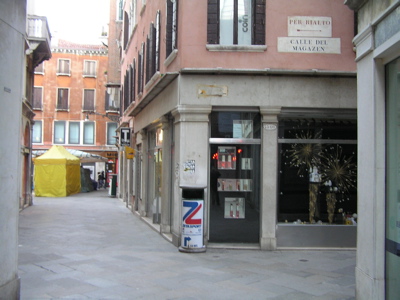
than the bridges on Riva degli Schiavoni) from where you can see the campanile di San Marco. |
 |
 |
|
Calle del Magazen near Campo San Luca |
Campo San Bartolomeo |
| As
we cross Campo San Salvador
and come into Campo San Bartolomeo, a commercial hub, to your left is
the Rialto bridge, to your right the Merceria
or Marzaria, the
shopping district of Venice, and straight ahead Ponte de l'Olio that
connects the sestieri of San
Marco and Cannaregio. Before the steps of the Rialto bridge, to your
right, if you lift your eyes you will see a golden head that used to be
the emblem of an old apothecary, Alla
Testa d'Oro, that specialized in triaca or teriaca a cure-all preparation
with many ingredients that the Venetians cleverly marketed. |
 |
 |
 |
| The
Rialto Bridge shopping area |
Whimsical
umbrellas at the beginning of the Merceria |
Alla Testa d'Oro |
 |
If you reach Ponte de l'Olio,
you will be standing in a very unique
spot. It is the only point in the city from where you can see four sestieri all at once.
If you stand in the middle of the bridge with your back to Campo San
Bartolomeo, to your left is San Polo, to your right Castello, ahead of
you Cannaregio, and behind you San Marco. Turn around and you will see
the last number of the sestiere
of San Marco and the end of the
tour.
 |